

Geographic tongue, also called erythema migrans and benign migratory glossitis, is a common benign condition, usually occurring on the dorsal and lateral surfaces of the tongue in approximately 1-2% of the population.
ETIOLOGY
The cause is unknown, although there are reports of increased frequency of this condition in people with stress and psoriasis of skin.
Geographic tongue is postulated to also be associated with other conditions like atopy and Reiter’s syndrome.
💡NOTE
There have been studies showing an increase number of certain Human Leukocyte Antigens (HLA-Cw6) in geographic tongue and psoriasis. Moreover, these lesions share similar histopathological features and both these lesions may simultaneously co-exist in the same patient. This has led to speculations of whether geographic tongue represents a psoriatic form of the disease in the mouth, although it is yet to be proven substantially!CLINICAL FEATURES
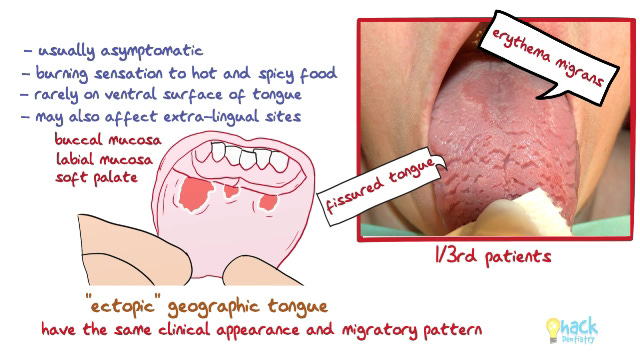
Geographic tongue has a slight female predilection and commonly manifests as multiple erythematous patches on the dorsal and lateral surfaces of the tongue.
These patches are caused by atrophy of the filiform papillae and are but not always, surrounded by white keratotic serpentine borders.
These red zones may be multiple isolated patches or may enlarge and coalesce forming a huge erythematous patch on the dorsal tongue.
💡NOTE
Patients may notice the lesions healing in a few days only to occur again after a few weeks in another area of the tongue. This pattern of loss and healing of the filiform papillae in different areas of the tongue has led to the condition being called “Benign migratory glossitis” and “Erythema migrans”. Also, these lesions resemble continental outlines on a map and hence the name “Geographic tongue”.Geographic tongue may be asymptomatic, being diagnosed during routine oral investigations or patients may sometimes complain of burning sensations to hot and spicy foods.
Approximately one-third of patients with fissured tongue are reported to have geographic tongue too.
Besides occurring on the dorsal and lateral tongue, these lesions may also rarely affect the ventral tongue and other mucosal sites, like buccal mucosa, labial mucosa and soft palate. These “ectopic”, extra-lingual lesions (ectopic geographic tongue) have the same clinical appearance and migratory pattern as the lesions appearing on the tongue.
HISTOPATHOLOGY
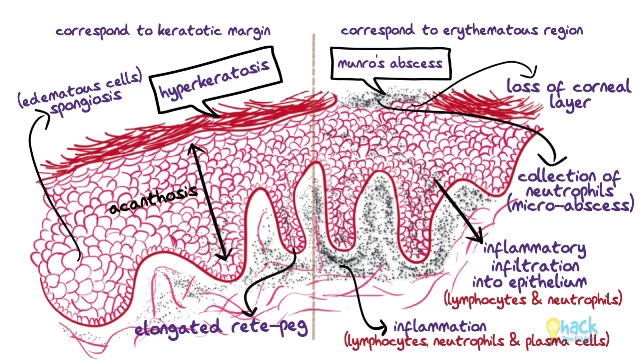
Areas corresponding to the white margins of the lesion demonstrate hyperkeratosis, spongiosis, acanthosis and elongated rete-pegs.
Areas corresponding to the central erythematous portion of the lesion show an intra-epithelial infiltration of neutrophils and lymphocytes and loss of keratin layer. This collection of neutrophils in the corneal layer is a micro-abscess and is called Munro’s abscess.
The immediate subjacent connective tissue may show inflammation comprising of lymphocytes, neutrophils and plasma cells.
TREATMENT
Geographic tongue does not require any treatment and reassurance is all that is required.
Very rarely, burning sensations might be severe and topical corticosteroids like betamethasone may be applied for relief.
✅HIGHLIGHTS - VIVA & ENTRANCE EXAM PERSPECTIVE
Geographic tongue, also called erythema migrans and benign migratory glossitis, is a common benign condition, usually occurring on the dorsal and lateral surfaces of the tongue in approximately 1-2% of the population.
The cause is unknown, although there are reports of increased frequency of this condition in people with stress and psoriasis of skin.
There have been studies showing an increase number of certain Human Leukocyte Antigens (HLA-Cw6) in geographic tongue and psoriasis.
Geographic tongue commonly manifests as multiple erythematous patches on the dorsal and lateral surfaces of the tongue.
These patches are caused by atrophy of the filiform papillae and are but not always, surrounded by white keratotic serpentine borders.
Patients may notice the lesions healing in a few days only to occur again after a few weeks in another area of the tongue. This pattern of loss and healing of the filiform papillae in different areas of the tongue has led to the condition being called “Benign migratory glossitis” and “Erythema migrans”.
Also, these lesions resemble continental outlines on a map and hence the name “Geographic tongue”.
Approximately one-third of patients with fissured tongue are reported to have geographic tongue too.
📖REFERENCES AND FURTHER READING
Neville BW, Damm DD, Allen CM, Chi A. Oral and Maxillofacial Pathology. South Asian ed. Elsevier; 2016.
Rajendran R, Sivapathasundaram B. Shafer’s Textbook of Oral Pathology. 7th ed. Elsevier; 2012.
Regezzi JA, Sciubba JJ, Jordan RCK. Oral Pathology: Clinical Pathologic Correlations. 5 th ed. Elsevier; 2007.