

Osteoclasts are large multinucleated giant cells having a few dozen nuclei, whose function is to resorb bone.
They play a very important role in bone remodelling and are characterized by the presence of an enzyme called tartrate resistant acid phosphatase(TRAP).
Osteoclasts are haematopoietic in origin and are derived from the monocyte/macrophage lineage of cells.
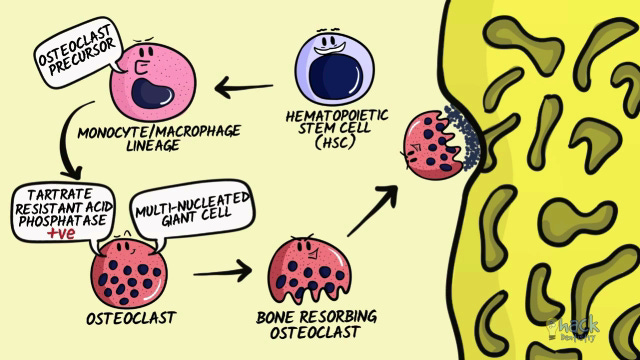
Haematopoietic stem cells within the bone marrow give rise to 2 lineages of cells – the common myeloid progenitors (CMP) and lymphoid progenitors (CLP).
Under the influence of cytokines like granulocyte/macrophage colony stimulating factor (GM-CSF), CMP further give rise to granulocyte/macrophage progenitors (GMP).
It’s worth noting that two cytokines, macrophage colony stimulating factor (M-CSF) and RANK ligand (RANKL) play key roles in the formation of osteoclasts.
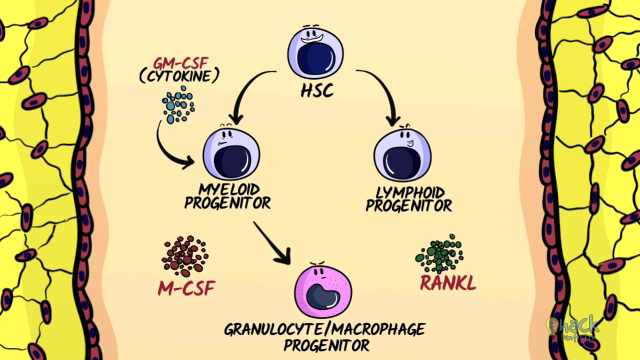
The adjacent bone marrow stromal cells and osteoblasts produce M-CSF which helps in differentiation of GMPs to** monocyte/macrophage lineage of cells** which are thought to be osteoclast precursor cells.
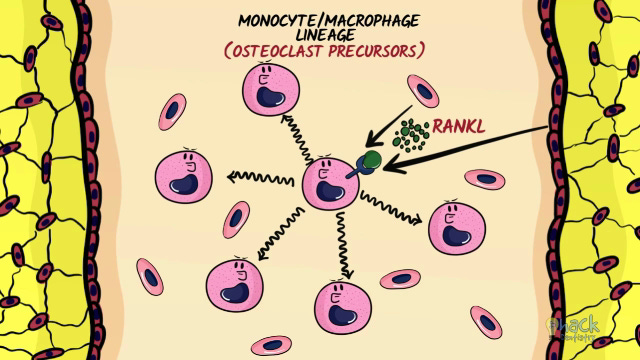
Osteoclast precursor cells are positive for TRAP and a RANK receptor and M-CSF is primarily responsible for proliferation and survival of osteoclast precursors!
Bone marrow stromal cells and osteoblasts are also responsible for secreting RANKL which combines with the RANK receptor on the osteoclast precursors.
This induces a signalling cascade leading them to fuse with other precursor cells to form multinucleated giant cells.
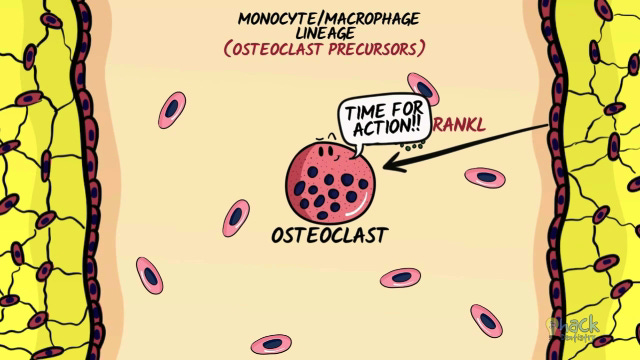
Apart from RANKL, another protein called osteoprotegerin (OPG) secreted by osteoblasts act as a decoy for RANKL and reduces osteoclast differentiation.
Osteoprotegrin binds with RANKL and prevents it from binding to RANK receptor.
REFERENCES AND FURTHER READING
Feng X, Teitelbaum SL. Osteoclasts: New Insights. Bone Res. 2013;1(1):11-26.
Nanci A. Tencate’s Oral Histology. Development, Structure and Function. 8th ed. Elsevier;2013.
Kumar GS. Orban’s Oral Histology and Embryology.13th ed. Elsevier;2011.