

Nicotine stomatitis (NS) or “smoker’s palate” is a form of keratosis occurring on the hard palate due to long term smoking.
Many people with this lesion are unaware of its presence and live with it for many years before reporting it.
It is very commonly seen in pipe smokers. However, it is also present in patients with cigarette and cigar smoking, though, less commonly.
Interestingly, it has also been rarely reported in people with long term use of hot beverages.
ETIOLOGY & PATHOGENESIS
NS is associated with long term tobacco smoking.
Though called “nicotine” stomatitis, the lesion is not due to the chemical content of the nicotine itself. It is rather, due to the heat generated by the tobacco product.
The heat may act as a local irritant, leading to a reactionary hyperplasia and keratosis of the palatal epithelium, and inflammation of the minor salivary gland ducts of the palate.
Hence, the palate of a denture wearer (who chronically smoke) is protected from developing this lesion.
💡REVERSE SMOKING
There is a form of smoking called “reverse smoking” that has been reported in various populations in Philippines, The Caribbean, Columbia and India.
The tobacco product is reverse smoked with the lit end/burning end of the cigarette inside of the oral cavity.
The changes on the palate caused as a result is collectively termed “Palatal lesions/changes due to reverse smoking” (because there could be a variety of changes apart from just keratosis) and should not be confused with nicotine stomatitis.
Palatal lesions/changes due to reverse smoking are potentially malignant with a high rate of malignant transformation.
DID YOU KNOW?

- In India, reverse smoking is quite prevalent among fishermen of coastal rural Andhra Pradesh.
- In the local language this habit is called "Adda Poga".
- The tobacco product is made by rolling dried tobacco twigs and is called "chutta".

Reference:
Bharath TS, Kumar NG, Nagaraja A, Saraswathi TR, Babu GS, Raju PR. Palatal changes of reverse smokers in a rural coastal Andhra population  with review of literature. J Oral Maxillofac Pathol. 2015;19(2):182-187.
CLINICAL FEATURES
NS is commonly found in men, probably because the habit is more prevalent among men.
NS can appear at any age, though it is commonly reported in the older age group, usually 45 years and up.
The lesion is confined to the mucosa of the hard palate, usually the posterior region.
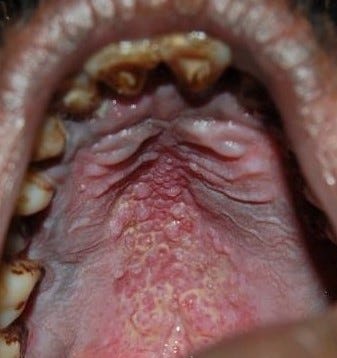
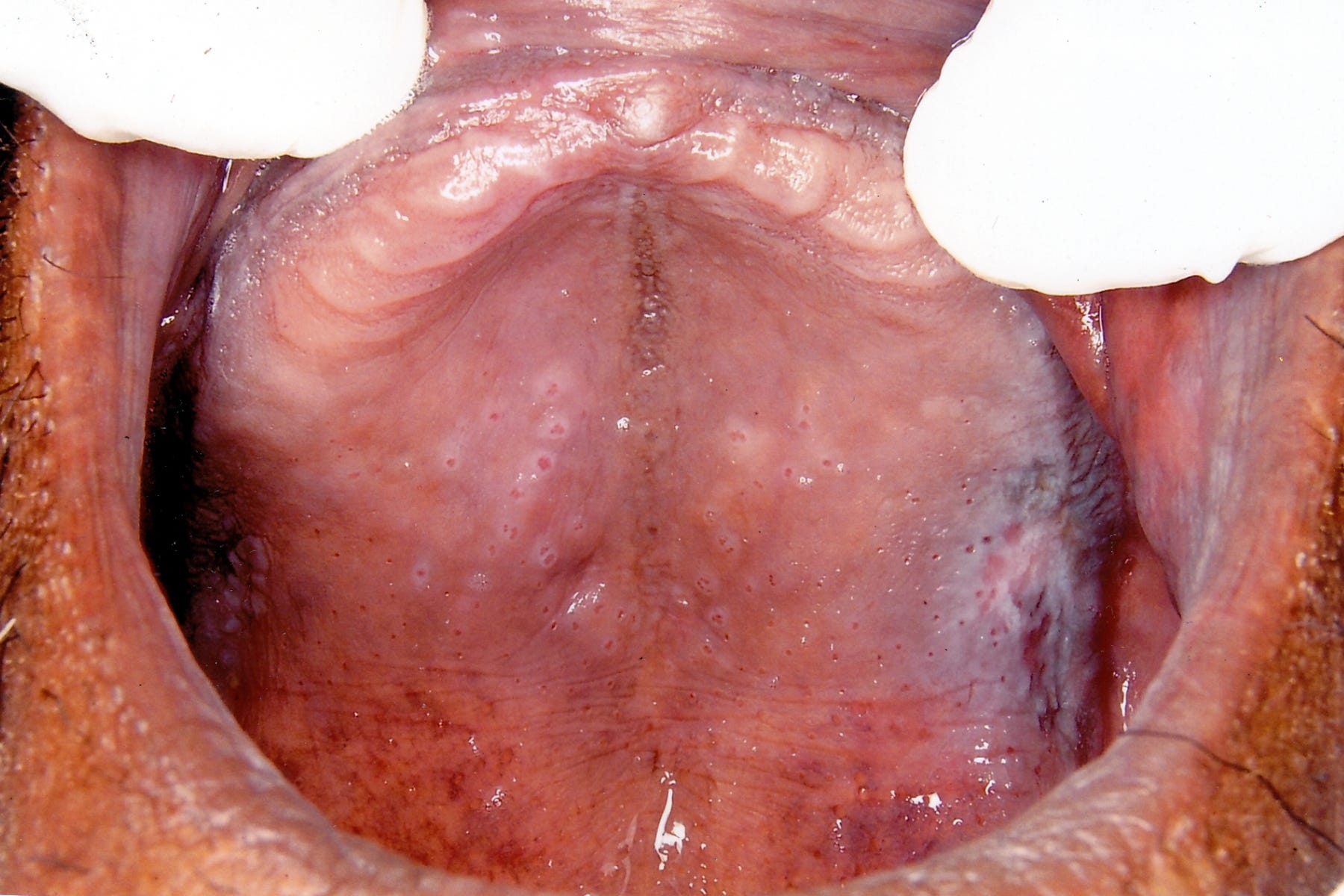
NS is a diffuse white, keratotic lesion with numerous raised papules that have red punctate centres.
The lesion is usually fissured or wrinkled.
The raised papules with red centres represent inflamed minor salivary gland ducts.
The lesion starts of as diffuse erythema and progresses to become white, thickened, fissured and wrinkled.
Patients are asymptomatic and are not aware of the lesion until later.
💡 PALATAL CHANGES THAT OCCUR DUE TO REVERSE SMOKING
Reverse smoker’s palate unlike nicotine stomatitis, can manifest with a variety of appearances.
Keratosis
Raised white patches
Diffuse red areas
Ulcerated areas
Areas of hyperpigmentation and depigmentation
HISTOPATHOLOGY FEATURES
The lesion, under the microscope, shows hyperkeratosis and acanthosis of the epithelium.
The connective tissue and the areas around minor salivary gland ducts may show mild to moderate inflammation.
In addition, there may be squamous metaplasia of the salivary gland ductal epithelium.
The epithelium does not show epithelial dysplasia.
REMEMBER...

- Nicotine stomatitis (NS) arises as a result of the heat generated by the tobacco product and is not due to the tobacco itself.
- Therefore NS, though arising in chronic smokers, is not a potentially malignant disorder.
- In fact, the epithelium does not show dysplastic changes.
TREATMENT
The lesion is completely reversible and resolves on cessation of smoking.
The lesion should generally resolve within a week or two (if smoking is stopped).
CAUTION
If the lesion persists for more than 4 weeks even after cessation of the smoking habit, the clinician may have to exercise caution. Such lesions (which do not regress/resolve) may well be leukoplakias, and may deserve further scrutiny to check for dysplastic changes.
Though NS is not potentially malignant, it is a marker for heavy, long term tobacco smoking. In such patients, it is better to check for any suspect premalignant lesions elsewhere in the oral cavity.

HIGHLIGHTS - VIVA & ENTRANCE EXAM PERSPECTIVE
Nicotine stomatitis (NS) or “smoker’s palate” is a form of keratosis occurring on the hard palate due to long term smoking.
It is very commonly seen in pipe smokers. However, it is also present in patients with cigarette and cigar smoking, though, less commonly.
Though called “nicotine” stomatitis, the lesion is not due to the chemical content of the nicotine itself. It is rather, due to the heat generated by the tobacco product.
The heat may act as a local irritant, leading to a reactionary hyperplasia and keratosis of the palatal epithelium, and inflammation of the minor salivary gland ducts of the palate.
In reverse smoking, the tobacco product is reverse smoked with the lit end/burning end of the cigarette inside of the oral cavity.
Palatal lesions/changes due to reverse smoking are potentially malignant with a high rate of malignant transformation.
NS is a diffuse white keratotic lesion with numerous raised papules that have red punctate centres. The lesion is usually fissured or wrinkled.
The raised papules with red centres represent inflamed minor salivary gland ducts.
Remember that NS, though arising in chronic smokers, is not a potentially malignant disorder. In fact, the epithelium does not show dysplastic changes.
REFERENCES AND FURTHER READING
Neville BW, Damm DD, Allen CM, Chi A. Oral and Maxillofacial Pathology. South Asian ed. Elsevier; 2016.
Rajendran R, Sivapathasundaram B. Shafer’s Textbook of Oral Pathology. 7th ed. Elsevier; 2012.
Sapp JP, Eversole LR, Wysocki GP. Contemporary Oral and Maxillofacial Pathology. 2 nd ed. Mosby; 2004.
Regezzi JA, Sciubba JJ, Jordan RCK. Oral Pathology: Clinical Pathologic Correlations. 5 th ed. Elsevier; 2007.
Keiles DG. Nicotine Stomatitis. 2016. Available from http://emedicine.medscape.com/article/1076183-overview
Marx RE, Stern D. Oral and Maxillofacial Pathology. 1st ed. Quintessence Publishing Co, Inc; 2003.
Bharath TS, Kumar NG, Nagaraja A, Saraswathi TR, Babu GS, Raju PR. Palatal changes of reverse smokers in a rural coastal Andhra population with review of literature. J Oral Maxillofac Pathol. 2015;19(2):182-187.